When planning a mid-size event, one of the most significant decisions involves the lighting system:
Should you rent lighting equipment, or buy it outright?
This decision directly affects budget efficiency, event quality, and long-term flexibility. In this article, we break down both options—renting vs buying—by analyzing total costs, use frequency, control flexibility, and maintenance factors. Whether you're an event planner, venue manager, or production coordinator, this guide helps you make the best choice for your needs.
I. What Qualifies as a Mid-Size Event?
A mid-size event typically hosts between 200 to 800 attendees, such as:
Corporate conferences and annual meetings
Boutique music performances or DJ sets
Small city festivals
Wedding galas or themed showcases
Such events demand lighting that ensures a professional look without requiring massive infrastructure.
Typical lighting needs may include:
Main front lighting: LED pars, Fresnels, profile spots
Effects lighting: Beam or moving head fixtures
Atmosphere: Ambient uplighting, wall washers
Control systems: DMX consoles, WiFi or app-based systems
Understanding this framework is the foundation for choosing between renting and buying.
II. Benefits of Renting Lighting Equipment
High Flexibility and Low Initial Cost
Renting gives you immediate access to professional-grade gear without the financial burden of ownership. This is ideal for:
One-off or infrequent events
Projects with tight lead times
Clients with uncertain or evolving technical specs
Most professional rental companies also provide:
Equipment transportation
On-site installation
Lighting programming or technician services
Emergency replacements
This allows event organizers to focus more on event delivery rather than technical logistics.
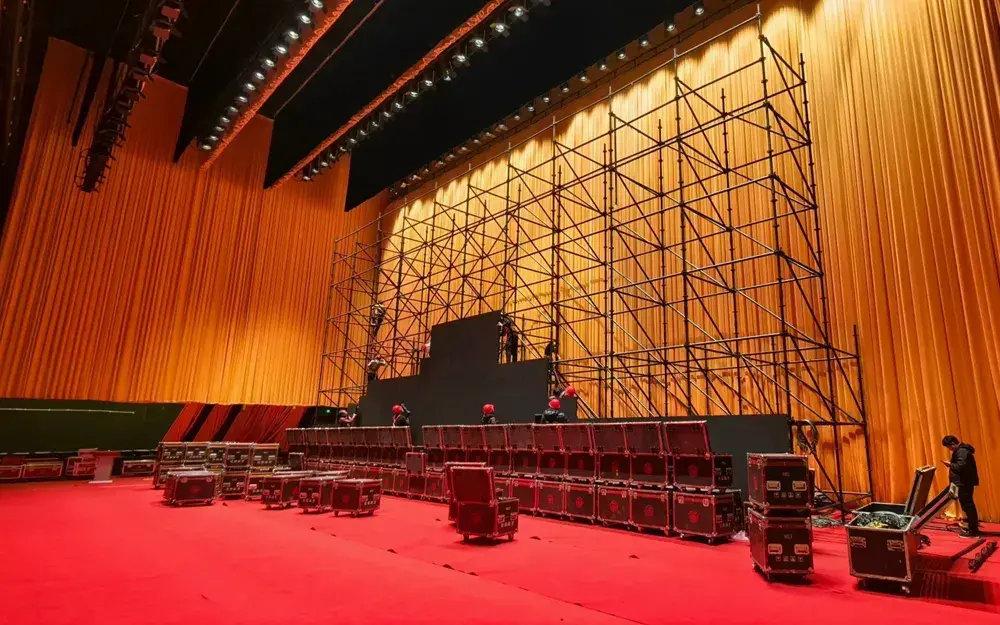
Low Risk, Fast Turnaround
Because there’s no long-term commitment, rentals reduce exposure to asset depreciation or repair liabilities. You pay for what you use—and only when you use it.
Suggested Placement for Illustration
| Illustration | Caption |
|---|---|
| Image 1 | Rental team installing moving heads |
| Image 2 | Snapshot of a rental contract and terms |
III. Advantages of Buying Equipment
Lower Long-Term Costs (If Used Often)
If your organization hosts at least three events a year, ownership starts to make financial sense. The cost per use drops rapidly across years of usage. This is especially true if:
The lighting setups are repeatable
The venue or stage area is fixed
You have trained in-house technicians
Full Customization and Technical Control
Buying gives you the freedom to:
Customize control programs and scenes
Select fixtures that match your branding or long-term artistic needs
Reduce dependence on third-party availability
A Strategic Asset for Growing Event Firms
For production houses, agencies, or venues, owning lighting infrastructure enhances:
Client trust
Response speed
In-house creative capabilities
Over time, your inventory becomes a differentiator, especially in a competitive local market.
IV. Cost Comparison: Renting vs Buying (5-Year Model)
Let’s take a typical 2-day event for 500 people and compare the 5-year cost projection:
| Equipment Type | Rental (Per Use) | Purchase Cost | 5-Year Total (Rental) | 5-Year Total (Purchase) |
|---|---|---|---|---|
| Main Lighting | ¥8,000 | ¥30,000 | ¥40,000 | ¥30,000 |
| Ambient Lighting | ¥3,500 | ¥12,000 | ¥17,500 | ¥12,000 |
| Control System | ¥1,500 | ¥8,000 | ¥7,500 | ¥8,000 |
| Setup + Transport | ¥2,500 | — | ¥12,500 | ¥3,000 (in-house labor) |
| Maintenance / Depreciation | — | — | — | ¥6,000 |
| Total | ¥27,500 | ¥50,000 | ¥77,500 | ¥59,000 |
Ownership becomes cost-effective after roughly 3–4 events, assuming technical stability and reuse.
V. The Hybrid Approach: Buy Some, Rent Some
Many event teams adopt a hybrid strategy:
Buy staple gear: PAR lights, uplights, basic controllers
Rent specialized fixtures: beam lights, waterproof strobes, or pixel bars for large setups
This minimizes long-term cost while preserving flexibility for project-specific upgrades. It also lets you maintain a streamlined gear room while still accessing high-output devices when needed.
VI. Other Key Considerations
1. Storage & Logistics
Ownership means:
Physical storage space
Protection from dust/moisture
Transportation to and from venues
Insurance and asset management
Rentals eliminate all these concerns, offloading the logistics to your supplier.
2. Staff Capability
Ask yourself:
Do we have someone trained in DMX programming?
Can our team install truss systems or adjust beam angles?
If not, purchasing may require parallel investment in training or hiring.
3. Local Market Supply
In cities where rental resources are scarce or overpriced, purchasing even for low-frequency use can become cost-justified. Conversely, areas with strong rental ecosystems often offer better service than solo operation.
VII. Decision Chart: When to Rent vs Buy
| Scenario | Recommended Option |
|---|---|
| One-time annual event | Rent |
| Three or more events per year | Buy |
| Consistent venue/stage format | Buy |
| High event diversity or client turnover | Rent |
| Access to storage and trained crew | Buy |
| Limited upfront capital / risk aversion | Rent |
VIII. Final Thoughts
There’s no absolute answer—only the right decision for your use case. Whether you prioritize:
Short-term cost control (rent)
Long-term ROI and customization (buy)
Or operational balance (hybrid)
—your choice should ultimately serve the quality and professionalism of your event.
Don’t just ask, “Which is cheaper?”
Ask instead, “Which gives us the best control, quality, and value over time?”
READ MORE:



Blue Sea Lighting is an enterprise with rich experience in the integration of industry and trade in stage lighting and stage special effects related equipment. Its products include moving head lights, par lights, wall washer lights, logo gobo projector lights, power distributor, stage effects such as electronic fireworks machines, snow machines, smoke bubble machines, and related accessories such as light clamps.
Quick Links
For more questions subscribe to our email