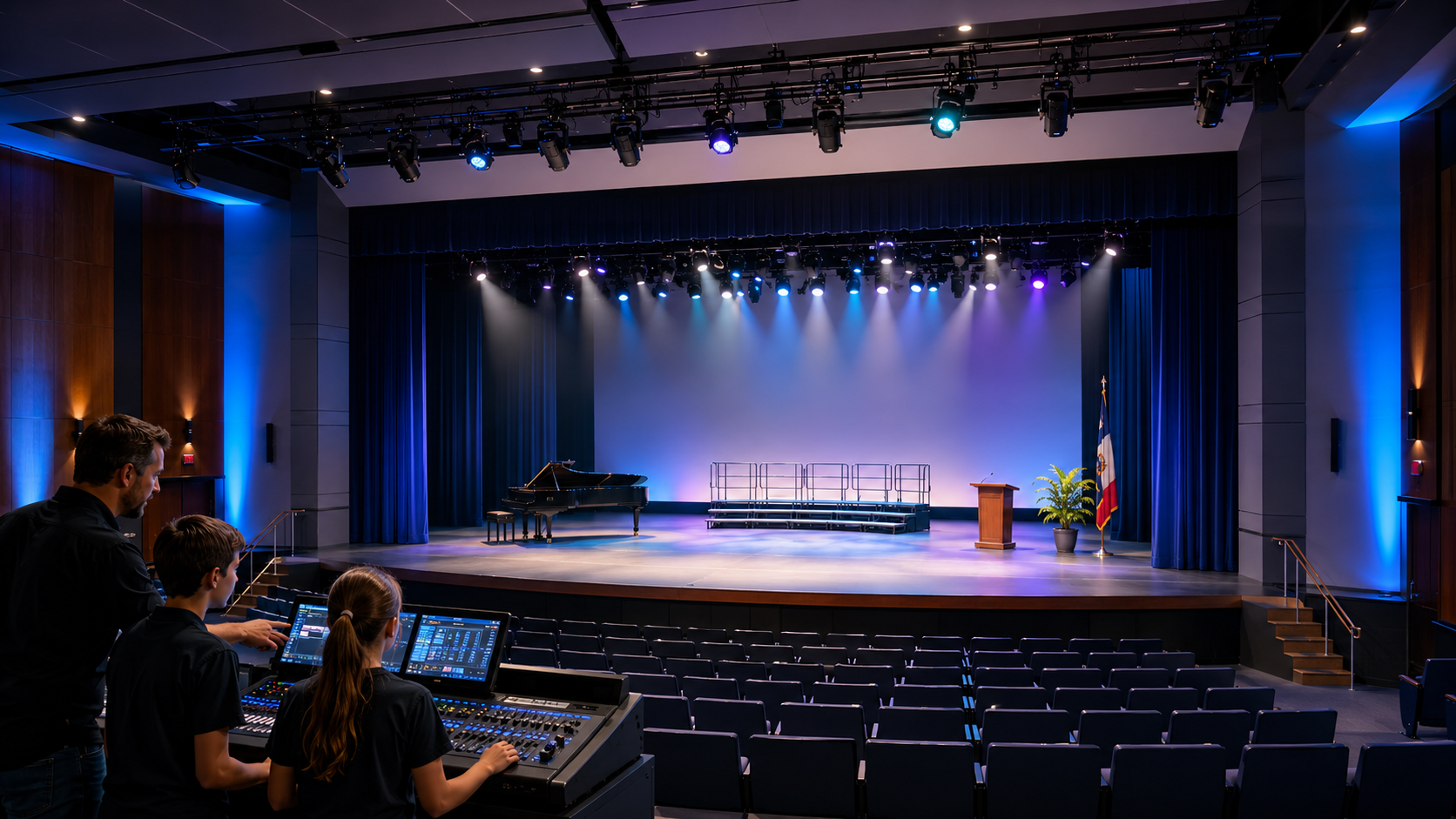
School theaters and auditoriums are important spaces for education, performance, celebration, and communication. In many schools, the auditorium is used for daily assemblies, speeches, drama performances, music concerts, award ceremonies, graduation events, parent meetings, and student activities. Because one space often serves many different purposes, the stage lighting system must be safe, flexible, and easy to operate.
A good school stage lighting system does not have to be overly complicated. It should help people see clearly, create a suitable atmosphere, support different event types, and allow teachers or students to control the lighting with confidence. For schools, the best lighting solution is usually not the most complex one, but the one that balances safety, reliability, multi-function use, and simple operation.
This guide explains the key points schools should consider when planning theater and auditorium stage lighting, including safe fixture installation, universal lighting configurations, and teaching-friendly control systems.
Safety First: Secure Installation for School Environments
Safety is the first rule for any school theater or auditorium lighting system. In a campus environment, lighting equipment may be used by teachers, students, technicians, volunteers, or visiting performance teams. Since many users may not be professional stage engineers, the system must be designed with extra attention to safety.
Stage lights should always be installed on strong and suitable structures, such as fixed lighting bars, stage trusses, ceiling pipes, or professional wall-mounted brackets. Ordinary hooks, weak pipes, or temporary supports should not be used. Before installing fixtures, every lighting position should be checked for load capacity.
Each hanging fixture should be secured with a professional clamp and a safety cable. The clamp holds the fixture in position, while the safety cable provides secondary protection. If the clamp becomes loose or fails, the safety cable helps prevent the fixture from falling. This is especially important in school environments because students, teachers, performers, and visitors may stand or walk below the equipment.
Power management is another important safety point. Stage lighting systems often require more electricity than normal classroom devices. Schools should avoid overloading wall sockets, extension cords, or low-quality power strips. Separate circuits, proper power distribution, grounding protection, and clearly labeled cables can reduce risks.
Cable management should also be part of the safety plan. Cables should not lie loosely across walking paths. If cables must cross the floor, they should be covered with cable ramps or properly secured. In backstage areas, cables should be organized to avoid tripping hazards. In ceiling or truss areas, cables should be fixed neatly and should not hang freely.
LED fixtures are usually a better choice for schools because they produce less heat, save energy, and require less maintenance than traditional lamps. However, LED fixtures still need proper ventilation. Air vents should not be blocked, and fixtures should not be installed too close to curtains, paper decorations, or other flammable materials.
Schools should also create simple safety rules for daily users. Students should not climb ladders or adjust overhead fixtures without supervision. Only trained adults or authorized technicians should change rigging positions. Lighting consoles should be protected from liquids, dust, and accidental operation. Emergency exits and aisles should never be blocked by lighting stands, cables, or equipment cases.
Multi-function Lighting for Assemblies, Performances, and Ceremonies
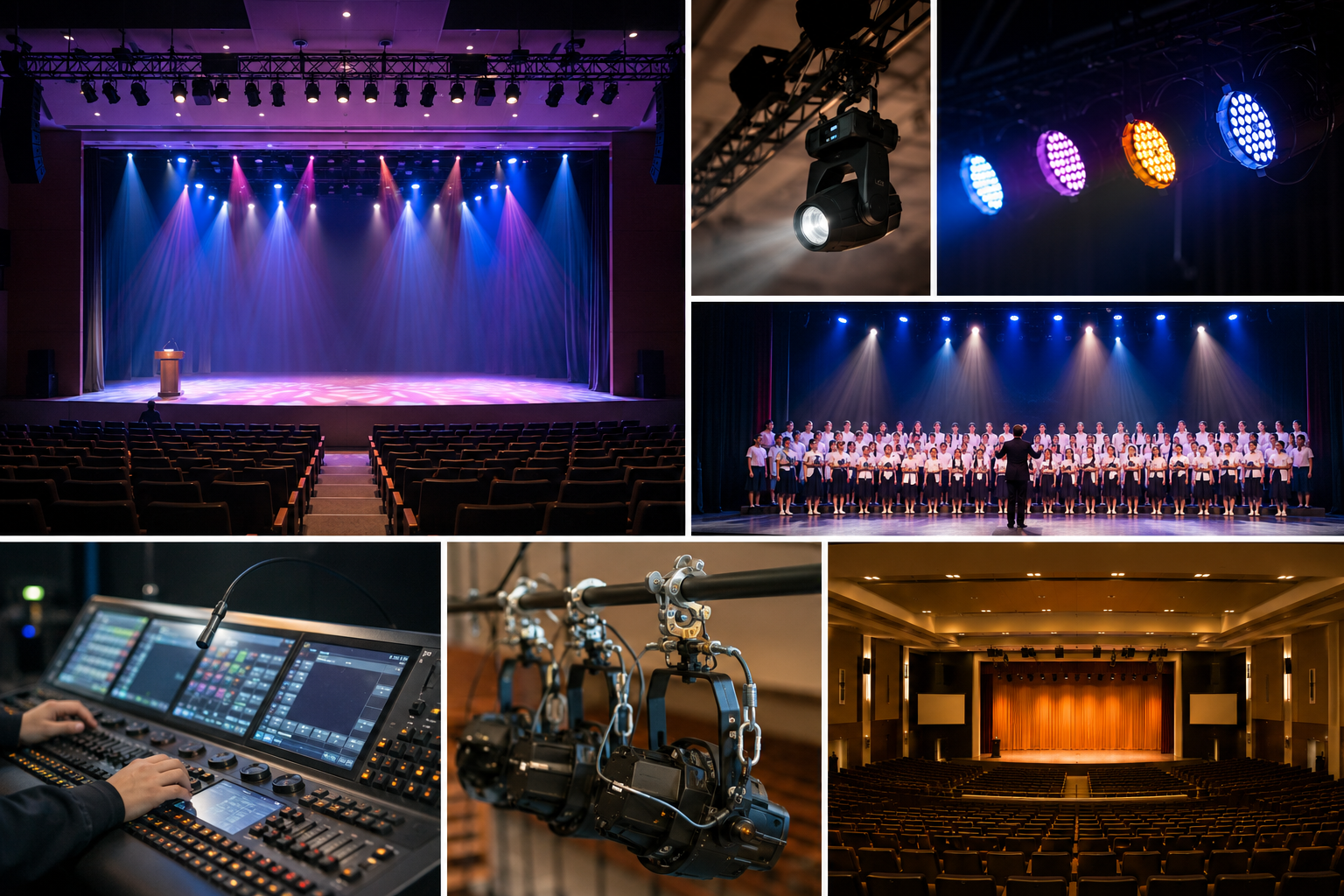
School auditoriums are usually multi-purpose spaces. One day, the stage may be used for a principal’s speech. The next day, it may host a dance rehearsal, a drama performance, a school band concert, or a graduation ceremony. Therefore, the lighting system should be flexible enough to support different scenes without requiring a complete equipment change every time.
A general school auditorium lighting setup should begin with reliable front lighting. Front lights are essential for visibility. They allow the audience to see faces, expressions, costumes, and speakers clearly. For schools, front lights should be soft, even, and easy to adjust. LED profile lights, LED fresnel lights, or LED wash lights can be used for this purpose.
The stage also needs general wash lighting. Wash lights cover a wide area and provide an even base of light. They are useful for assemblies, lectures, choir performances, drama scenes, and award ceremonies. RGBW or RGBWA LED wash lights are especially useful because they can create white light for formal events and colored light for performances.
Back lighting helps create depth and separates performers from the background. Without back lighting, people on stage may look flat. With back lighting, the stage looks more professional and three-dimensional. Back lights can be simple white fixtures or color-changing LED fixtures.
Side lighting is useful for dance, drama, and movement-based performances. It highlights body lines and adds dramatic effect. In a school setting, side lights can be mounted on side booms, wall positions, or low stands when suitable. However, floor stands must be placed safely so they do not block exits or create tripping risks.
For events that need energy and excitement, schools can add moving head lights or beam lights. These fixtures can move, change color, project patterns, and create dynamic effects. They are suitable for talent shows, concerts, festivals, and opening ceremonies. A school does not need too many effect lights. A small number of reliable moving lights can already make the stage look modern and lively.
For daily operation, schools can create common lighting presets, such as “Assembly,” “Speech,” “Award Ceremony,” “Drama Warm Scene,” “Concert Blue Look,” “Dance Color Look,” and “Full Stage White.” Once these scenes are saved in the controller, teachers or student operators can quickly select the correct look for each event.
Teaching-friendly Control for Teachers and Students
In many schools, stage lighting is not controlled by full-time professionals. Teachers, student clubs, drama groups, music departments, and event volunteers may all need to operate the system. Therefore, the control interface must be simple and teaching-friendly.
A user-friendly lighting control system should have clear labels, simple menus, and saved presets. Users should be able to turn on basic stage lighting without complicated programming. For example, a teacher preparing for a speech should be able to select a “Lecture” or “Assembly” preset. A student running a talent show should be able to select a colorful performance scene and adjust brightness easily.
DMX control is common in stage lighting. DMX allows one controller to control many fixtures through signal cables. However, DMX addresses, channels, and programming can feel difficult for beginners. To make operation easier, schools can use pre-programmed scenes and simple control pages. The technical setup can be handled by a lighting supplier or trained technician, while daily users only need to select scenes and make basic adjustments.
Some modern lighting controllers use touch screens, software interfaces, or app-based control. These can be friendly for education because students can visually understand color, intensity, movement, and timing. However, schools should choose systems that are stable and not too dependent on complex software updates or advanced networking knowledge.
A basic training plan is also important. Students and teachers should learn terms such as intensity, color, fade time, scene, cue, blackout, front light, back light, and wash. They should also learn what not to do, such as unplugging cables randomly, changing fixture addresses without permission, or shining bright beams directly into people’s eyes at close range.
Lighting control can become a valuable teaching tool. Students can learn how lighting changes emotion, focus, and storytelling. In drama classes, they can compare a warm scene with a cold scene. In music performances, they can match lighting changes with rhythm. In ceremonies, they can learn how formal lighting supports clear communication.
Recommended Lighting Configuration for School Auditoriums
A practical school theater or auditorium lighting system can be divided into four layers.
The first layer is basic visibility lighting, including front lights and general wash lights. These fixtures are used for almost every event and should provide clean, comfortable light.
The second layer is atmosphere lighting, including color wash lights, back lights, and side lights. These fixtures help create different moods, such as warm, cool, formal, festive, dramatic, or calm.
The third layer is effect lighting, including moving head lights, beam lights, gobo lights, and pixel effect lights. These are not needed for every event, but they can make performances more attractive.
The fourth layer is control and programming. A school lighting system should include a control console, DMX controller, wall panel, or software-based control system. The controller should be easy enough for teachers and students to learn.
For a small school stage, the system may include several LED par lights, a few front profile lights, some back wash lights, and a basic DMX controller. For a medium auditorium, the system may include front profile lights, LED fresnel or wash lights, RGBW par lights, moving head lights, and a console with scene memory. For a larger school theater, the system may include multiple lighting positions, advanced consoles, dimming or relay systems, and network-based control.
The correct choice depends on the stage size, ceiling height, event types, budget, and user skill level. The goal is not to fill the ceiling with equipment, but to create a balanced system that is safe, useful, and easy to manage.
Why LED Stage Lighting Is Suitable for Schools
LED stage lighting is highly suitable for school theaters and auditoriums. Compared with traditional halogen fixtures, LED lights usually use less power, produce less heat, last longer, and offer more color options. This makes them safer and easier to maintain.
For schools, LED par lights are a common choice. They are compact, affordable, and useful for color wash. LED profile lights are good for front lighting because they can shape the beam and reduce spill. LED fresnel lights provide soft and smooth light, which is useful for speeches and performances. LED moving head lights add dynamic effects for concerts and shows.
When choosing fixtures, schools should pay attention to build quality, brightness, color mixing, noise level, control modes, and maintenance needs. A quiet fixture is important for theater performances, speeches, and lectures. A durable housing is important because school equipment may be used by different groups over many years.
Schools should also consider spare parts and after-sales support. A lighting system is a long-term investment. Good supplier support can help with installation guidance, programming, training, troubleshooting, and future expansion.
Lighting Applications for Different Campus Events
For school assemblies, lighting should be clear and comfortable. The stage should be bright enough for speakers and presenters. White or warm white front lighting is usually suitable.
For drama performances, lighting should help tell the story. Different scenes may need different colors, brightness levels, and focus areas. Warm light can suggest daytime or comfort. Blue light can suggest night or sadness. Dim lighting can create mystery. A focused light can guide the audience’s attention.
For concerts and talent shows, lighting can be more colorful and dynamic. Wash lights, moving heads, and back lights can create energy. However, the lighting should still support the performers instead of distracting from them.
For award ceremonies and graduations, the lighting should look formal and elegant. Clear front lighting, soft background color, and balanced brightness are important. The stage should look good in photos and videos.
For lectures and parent meetings, lighting should be simple and practical. The speaker, podium, and screen should be visible. If a projector or LED screen is used, the lighting should not wash out the image.
Maintenance and Long-term Management
A school lighting system should be easy to maintain. Fixtures should be cleaned regularly, especially lenses, fans, and vents. Dust can reduce brightness and affect heat dissipation. Cables should be checked for damage. Connectors should be kept clean and dry. Lighting positions should be inspected after major events.
It is also useful to keep a lighting system record. This record can include fixture models, installation positions, DMX addresses, power circuits, controller settings, and saved scenes. When staff changes or new students join the technical team, this document helps them understand the system quickly.
Schools should also set rules for borrowing or moving equipment. Portable lights and stands should be returned to their correct place after use. Cables should be coiled properly. Fixtures should not be stored in wet, dusty, or unstable areas.
Conclusion
School theater and auditorium stage lighting should be safe, versatile, and easy to use. Safety begins with proper installation, secure rigging, reliable power management, organized cables, and regular inspection. Multi-functionality comes from a balanced lighting layout that supports assemblies, performances, ceremonies, lectures, and concerts. Teaching-friendly control allows teachers and students to operate the system confidently through simple presets, clear interfaces, and basic training.
A well-designed lighting system does more than illuminate a stage. It improves the quality of school events, supports student creativity, and turns the auditorium into a true learning environment. With the right planning, school theaters and auditoriums can become safer, brighter, more flexible, and more inspiring spaces for every student and every event.



Blue Sea Lighting is an enterprise with rich experience in the integration of industry and trade in stage lighting and stage special effects related equipment. Its products include moving head lights, par lights, wall washer lights, logo gobo projector lights, power distributor, stage effects such as electronic fireworks machines, snow machines, smoke bubble machines, and related accessories such as light clamps.
Quick Links
For more questions subscribe to our email