When music is played live, lighting can’t afford to fall behind. Automated timecode may rule pre-recorded shows, but syncing lighting with live instrumental cues remains one of the most rewarding and challenging aspects of live event production. Whether it's a drum hit, violin swell, or bass drop — lighting must feel instinctively tied to each moment.
This article explores how to achieve precise lighting synchronization in real-time with musical performance, using a combination of cueing strategies, show file architecture, and operator preparation.
Why Syncing to Live Cues Matters
Lighting that reacts to music in real time has powerful emotional impact:
Enhances musical phrasing with matching movement and intensity
Guides audience focus through lighting punctuation
Tightens the visual-musical relationship, making lighting feel like another instrument onstage
For shows like orchestral concerts, jazz sets, progressive rock, or modern dance with live accompaniment, syncing to cues adds immersion and narrative clarity.
Cueing Techniques: Manual vs Semi-Automated
1. Manual Playback (Busking)
Common in club and jam settings, this method relies on:
Operators hitting cues based on rehearsal familiarity
Grouping FX or color changes on faders or flash keys
Anticipating musical phrasing in real time
Pros:
Cons:
2. Timecode + Human Override (Hybrid)
Ideal for bands with consistent set structures:
Pre-sequenced base tracks (timecode) handle key beats
Operator manually adds flare, strobes, or mutes on musical nuance
Hybrid shows allow for both polish and spontaneity — a strobe hit on a kick drum might be automated, while LED color bumps match the bass improvisation.
Building Show Files for Musical Reactivity
Creating a responsive file means more than organizing cues:
Use cue stacks with timing offsets (e.g., bass to light fade after 0.25s)
Map musical sections (intro, verse, chorus) to faders or executor pages
Use clear naming that reflects music (e.g., “Bridge Strobe,” “Violin Rise Color Cue”)
Set priorities: is tempo-following or impact-matching more critical?
Keep a “safe fallback” page with neutral washes and color fades for moments when the music goes off-script.
Understanding Musical Structure
Lighting programmers should understand:
Studying a track’s waveform or MIDI chart can help design cues that mirror rhythm and structure. For acoustic shows, mark cue triggers like:
Lighting should visually reflect these musical actions — a sharp pan/tilt on brass hits, or a dimmer swell on string legato.
Training the Operator’s Ear and Reflexes
Operators who sync to music must:
Rehearse cues with the band
Know the musical phrasing and count structures
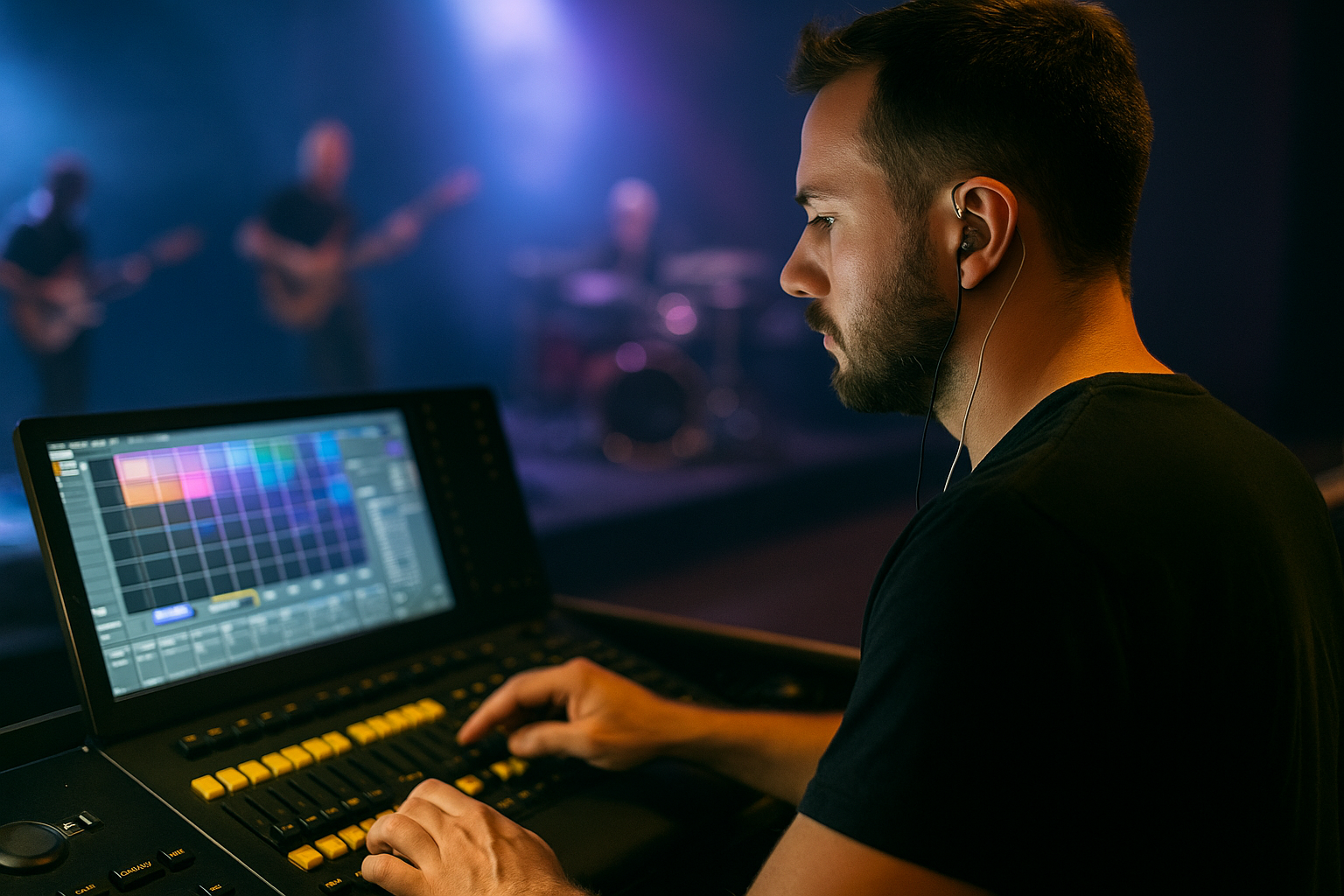
Use in-ear monitors for clearer instrument separation
Mark scripts with musical cue annotations (“Fade in 4 bars after flute”)
Practice muscle memory for faster reaction time
It’s not just about pressing GO — it’s about feeling the music ahead of time.
Common Mistakes to Avoid
Overloading the operator: Too many cues on a single page or playback
Ignoring rehearsal: Lighting must rehearse as much as musicians
One-size-fits-all lighting: Don’t repeat the same chase across every beat
Late cue placement: Lights should feel tight to the instrument, not lagging behind
When to Let the Music Lead
Sometimes the best sync isn’t exact — it’s emotional. A slow color fade that starts on a violin entrance might be enough, or a quiet dim on a rest moment. Not every cue needs to be literal.
What matters is that the lighting respects and enhances what the audience hears.