Suspending lighting fixtures from trusses or grids requires more than just secure clamps — it demands precise balance. Improperly balanced lights can tilt, shift focus, rotate off-axis, or even pose safety hazards. Before you lift a fixture into the air, it’s critical to check and adjust its center of gravity.
This article outlines best practices to ensure your lighting fixtures are properly balanced before flying, making your rig safer and more professional.
Why Fixture Balance Matters
An imbalanced fixture may:
Sag forward or backward, ruining focus or wash position
Exert uneven pressure on clamps, increasing fall risk
Affect movement accuracy on motorized heads
Interfere with neighboring fixtures during pan/tilt operation
Cause structural wear on truss elements
Whether you're rigging a moving head, PAR, strobe, or blinder, balancing before lifting saves time and prevents mid-rigging adjustments.
Step 1: Prep and Surface Check
Start on a flat surface or bench:
Lay the fixture flat and ensure feet or base are flush
Remove any transport caps, safety locks, or loose cabling
Ensure brackets are symmetrical and arms are not bent
Even small deformations can throw off weight distribution.
Step 2: Attach Mounting Hardware First
Install clamps, half-couplers, or omega brackets before attempting to balance. These affect weight distribution.
For yoke-style fixtures:
Mount the bracket or clamp to the yoke center
Avoid sliding one-sided or off-center due to bolt tension
Secure safety cables nearby, but not in the lift path
Many riggers mistakenly assume clamps don’t influence weight — they do.
Step 3: Locate the Center of Gravity
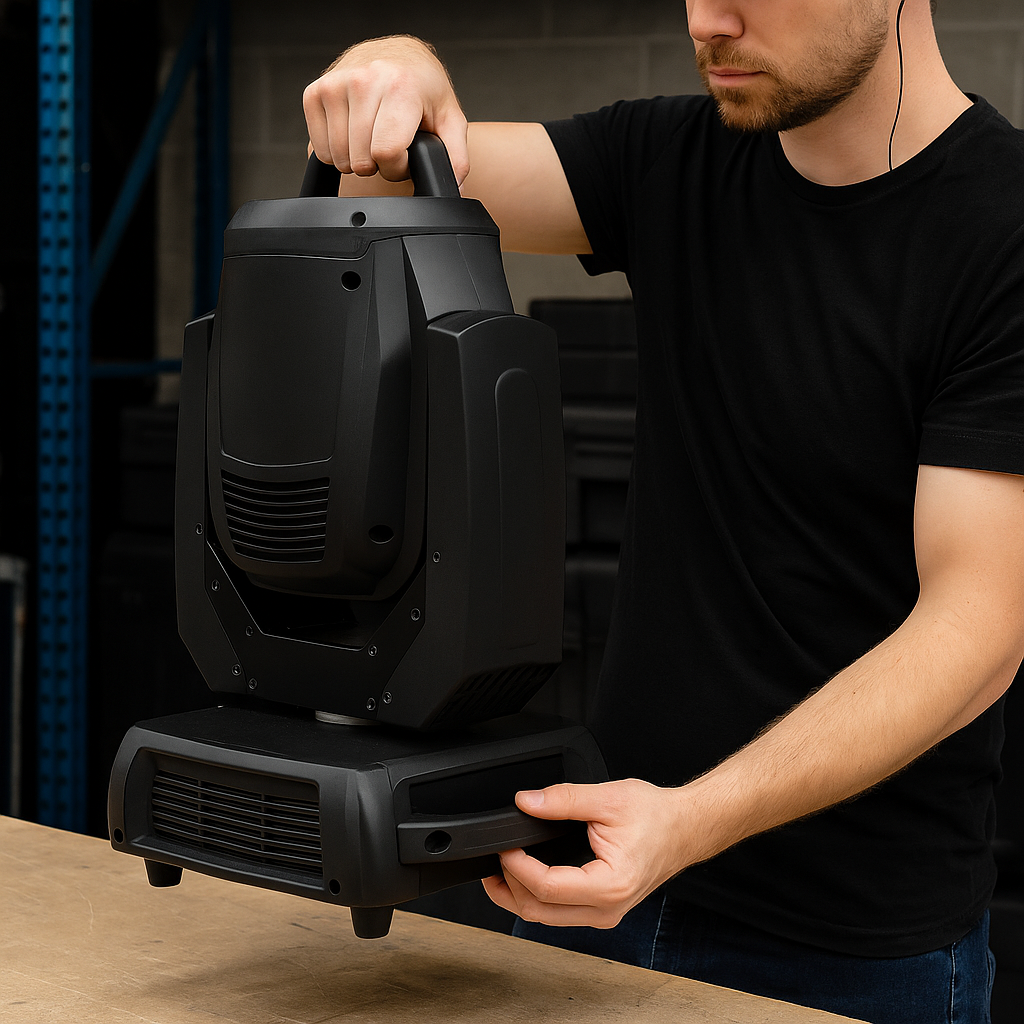
Gently lift the fixture by the center bracket with both hands. Does it:
Dip forward? The front is heavier
Dip back? Too much rear weight (often cables or yoke)
Stay level? Good — mark this spot
If unbalanced:
Adjust the mounting point on the yoke or bracket
Shift clamps slightly along T-slot or slotted bar
For LED bars or panel lights, test horizontal tilt as well
Mark balanced clamp positions with tape or Sharpie for future re-rigging.
Step 4: Test for Movement (If Motorized)
For moving head lights, power the unit and test pan/tilt ranges:
If balance is off, motors strain and slow down
Balanced fixtures move smoother and quieter
Watch for unwanted return drift (common in yoke-imbalanced units)
You don’t want to realize imbalance when the fixture is 25 feet up.
Step 5: Secure Before Lifting
Once balanced:
Tighten clamps and hardware fully
Attach safety cable to truss-rated structure
Keep cables dressed and bundled along fixture path
Double-check focus alignment and clearance envelope
Ready to fly.
Pro Tips
Use a cradle or lifting stand to simulate truss tilt before final lift
For dual-point rigging (e.g., LED panels), balance both axes (X and Y)
Always test in show orientation (portrait/landscape or tilt angle)
Store fixture + bracket combos in pre-marked positions for quick reuse
Common Balance Mistakes
| Mistake | Result |
|---|
| Mounting clamp after balance test | Throws off weight distribution |
| Using uneven brackets or adapters | Tilts fixture even if center is correct |
| Forgetting to balance under show tilt | Results in unexpected focus shift |
| Balancing on soft surface | Gives misleading readings |
Conclusion
Checking fixture balance is more than a safety step — it’s a precision step. Properly balanced lights not only protect crew and equipment but also perform better, focus more reliably, and reduce post-rigging adjustments.
Before your next rig, take the extra 90 seconds to check balance. It’ll save you minutes — or hours — down the line.