Understanding the Core Technologies
In the world of stage and event lighting, PAR lights are an essential component of almost every rig. They’re versatile, powerful, and come in a variety of configurations. But as technology evolves, designers often face the question: should I choose a traditional multi-LED PAR or a COB (Chip On Board) LED PAR?
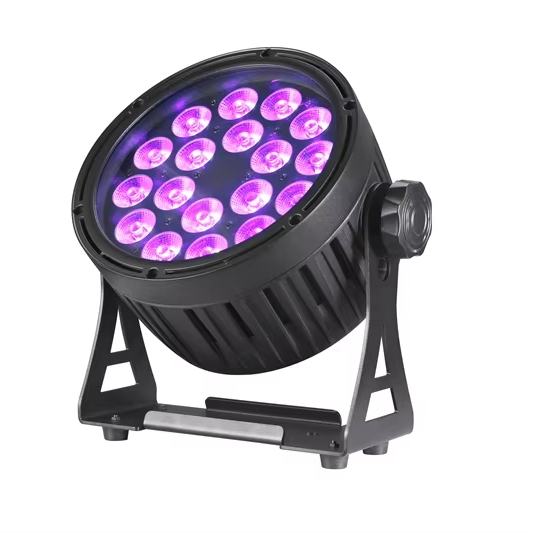
This article breaks down the key differences, benefits, and use cases of two leading fixtures—one representing each category. The 18x18w RGBWA UV 6in1 LED Par Can Light and the 7x40w RGBW 4in1 COB LED Par Stage Lights embody the capabilities of their respective technologies.
Multi-LED PARs: More Sources, More Flexibility
The 18x18w RGBWA UV 6in1 LED Par Can Light uses 18 individual 18-watt LEDs, each capable of outputting red, green, blue, white, amber, and ultraviolet light. This allows for fine-tuned color mixing, including pastel shades and vibrant UV effects.
This type of fixture is ideal for:
Weddings and event decor, where nuanced tones are needed.
Outdoor wash lighting, thanks to IP-rated housing.
Stages that require a wide palette including amber warmth or UV energy.
The beam spread from the 18x18w RGBWA UV 6in1 LED Par Can Light can be tighter or broader depending on optics, but typically offers more defined edges and multiple subtle gradients within a single field.
COB PARs: Single Source, Smoother Output
The 7x40w RGBW 4in1 COB LED Par Stage Lights utilize 7 high-power COB chips, each integrating red, green, blue, and white emitters onto a single diode surface. The result? Uniform, shadow-free washes that excel in blending.
Advantages of the 7x40w RGBW 4in1 COB LED Par Stage Lights include:
No pixelation—excellent for close-up audience viewing or photography.
Wider beam angles, ideal for flooding backdrops or floors.
Softer transitions between light zones.
This makes them especially effective in applications like:
Concert stages requiring bold, even color fields.
Theatrical lighting, where smooth gradients are preferred.
Architectural and DJ setups, needing clean color with no hot spots.
_A18r2L.jpg)
Color Mixing: Precision vs. Blend
While both lights offer color mixing, the approach differs:
The 18x18w RGBWA UV 6in1 LED Par Can Light allows precise mixing of individual channels, giving access to niche hues like soft ambers or high-energy UV purples.
The 7x40w RGBW 4in1 COB LED Par Stage Lights provide superior color blending within the beam, but with fewer native color components (no amber or UV), making them better for full-bodied primaries and white mixes.
Designers working on shows with brand-specific colors or theatrical cues may lean toward the 6-in-1, while those prioritizing beam homogeneity often prefer COB.
Output and Beam Quality
Power output differs not just in raw wattage, but also in how the beam looks and feels.
The 18x18w RGBWA UV 6in1 LED Par Can Light creates a multi-source beam. At a distance, these beams blend, but up close, the LED patterns may be visible. This is often not a concern for high-mount or distance-wash use.
The 7x40w RGBW 4in1 COB LED Par Stage Lights deliver a clean, seamless beam. There's no LED dotting, making them perfect for close-range or camera-facing roles.
COB’s smoothness comes at the cost of less color nuance—there's no UV or amber unless built into the chip.
Size, Heat, and Fan Noise
Heat dissipation and noise can impact lighting choice, especially in sensitive environments.
The 18x18w RGBWA UV 6in1 LED Par Can Light often uses active cooling and may emit slight fan noise.
The 7x40w RGBW 4in1 COB LED Par Stage Lights typically use passive or hybrid cooling, making them quieter—essential in theaters or galleries.
COB lights also consolidate more heat into fewer chips, so thermal design matters more. Still, many newer COB units excel in low-noise performance.
Control and Protocol Compatibility
Both models support DMX512 control, and in many cases RDM or wireless options. However, the 18x18w RGBWA UV 6in1 LED Par Can Light often offers more channels, allowing for:
In contrast, the 7x40w RGBW 4in1 COB LED Par Stage Lights usually offer simplified control schemes, making them quicker to set up and easier to patch, especially in time-constrained scenarios.
Price and Durability Considerations
From a pricing perspective:
Both options now come with rugged IP ratings for outdoor use, aluminum housings, and long LED lifespans—making either a reliable choice for frequent event use.
READ MORE: