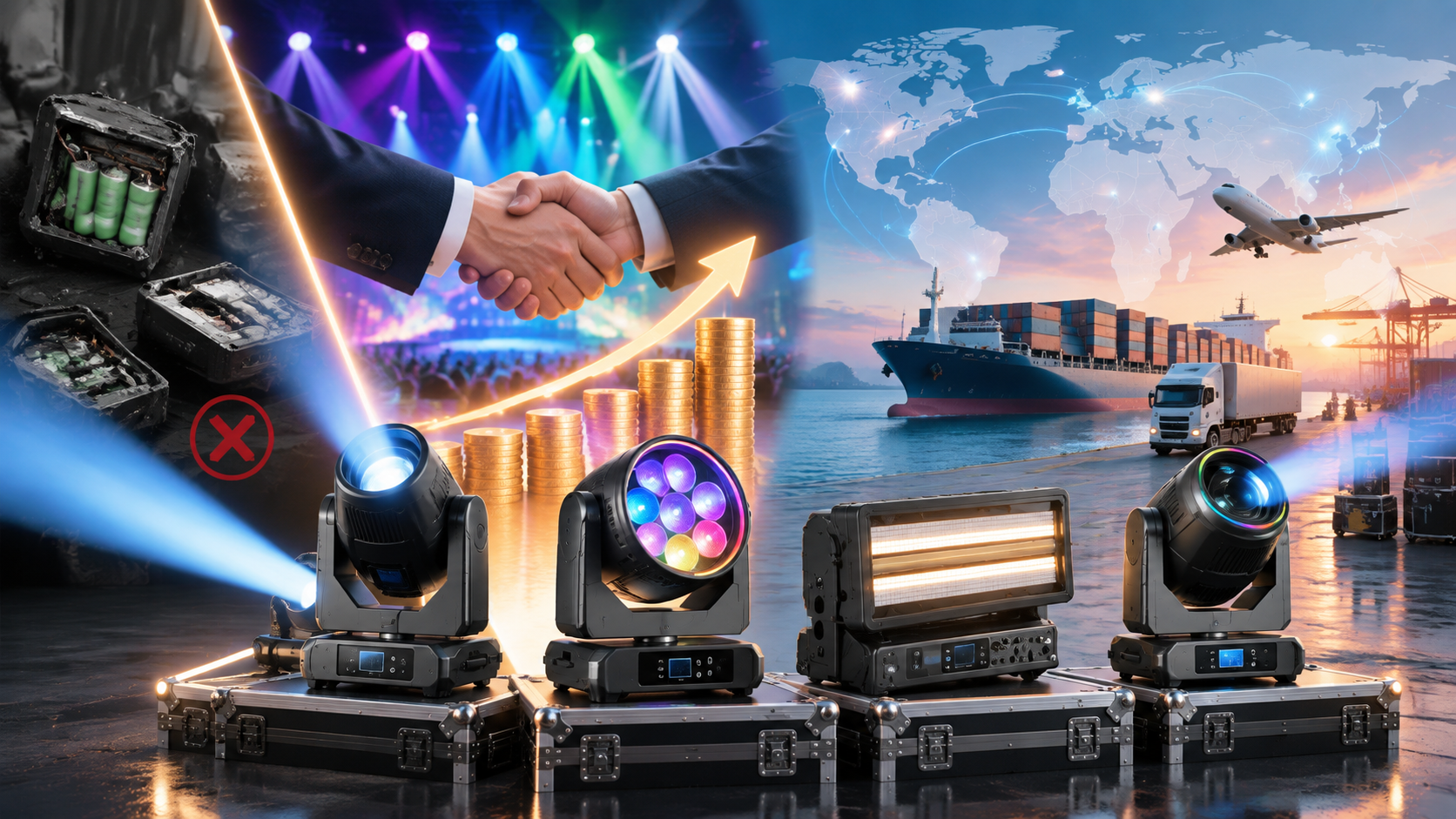
The professional stage lighting industry has experienced rapid growth in recent years. From concerts and festivals to corporate events, theaters, clubs, architectural projects, and large-scale entertainment venues, the demand for reliable lighting equipment continues to increase worldwide.
For B2B buyers, however, purchasing stage lighting equipment is not simply about finding the lowest price. A product with an attractive quotation may appear competitive at first, but hidden problems such as inaccurate power specifications, poor-quality batteries, unstable components, and high maintenance costs can create much larger expenses over the product’s lifetime.
Professional buyers, distributors, rental companies, and engineering contractors need to understand the real value behind stage lighting prices. The best investment is not always the cheapest product — it is the product that delivers stable performance, long service life, efficient maintenance, and dependable supplier support.
This guide explains how to make smarter purchasing decisions by focusing on four key factors: avoiding low-price traps, understanding factory wholesale advantages, evaluating logistics and warranty support, and calculating long-term operating costs.
1. Avoiding Low-Price Traps: Hidden Risks Behind Cheap Stage Lighting
When comparing stage lighting prices, many buyers naturally focus on the initial quotation. However, professional lighting equipment is a long-term investment, and the real cost is determined by performance, reliability, and maintenance requirements.
Some low-cost suppliers attract customers by offering extremely cheap prices, but these products may contain hidden problems that affect project quality and business reputation.
Fake Power Ratings: The Difference Between Marketing Numbers and Real Performance
One of the most common issues in the stage lighting market is inaccurate power labeling.
For example, a moving head light may be advertised as a “500W LED fixture,” but the actual LED output power may be significantly lower. Some manufacturers calculate total electrical consumption, use peak values, or exaggerate specifications to make products appear more powerful.
For professional applications, inaccurate power ratings can cause serious problems:
Insufficient brightness for large venues
Poor color rendering performance
Weak beam projection
Unstable operation during long events
Customer complaints after installation
A reliable manufacturer should provide clear technical specifications, including:
Actual LED module power
Optical system design
Output efficiency
Thermal management system
Testing standards
Professional buyers should always compare real performance rather than only comparing numbers on a product sheet.
Poor-Quality Batteries: A Hidden Cost in Battery-Powered Lighting
Battery-powered stage lighting has become increasingly popular because it provides flexible installation options for weddings, events, exhibitions, and outdoor performances.
However, battery quality directly affects product reliability.
Low-cost battery solutions often use:
Low-capacity lithium cells
Poor battery management systems
Limited charging cycles
Weak temperature protection
These problems can lead to:
Short working time
Sudden power failure during events
Reduced product lifespan
Increased replacement costs
For rental companies especially, battery reliability is critical. A lighting failure during a live event can damage customer trust and create additional labor costs.
A professional lighting supplier should focus on:
High-quality lithium battery cells
Intelligent charging protection
Battery temperature monitoring
Stable discharge performance
Safety certification compliance
Choosing a slightly higher initial investment can significantly reduce future operating risks.
2. Wholesale Advantages: Understanding Factory Direct Pricing Strategies
For B2B buyers, purchasing directly from a professional lighting factory provides important advantages compared with buying through multiple distributors.
A factory-direct supplier can offer more competitive pricing because unnecessary middle costs are reduced.
Blue Sea Lighting provides professional lighting solutions for global distributors, rental companies, and engineering projects with direct factory support and customized production capabilities.
How Factory Tier Pricing Works
Professional lighting manufacturers usually provide a tiered pricing strategy based on order quantity.
A typical structure includes:
| Order Quantity | Pricing Advantage | Suitable Customers |
|---|---|---|
| Small Quantity Orders | Standard wholesale price | New customers, testing projects |
| Medium Quantity Orders | Better unit cost | Rental companies, distributors |
| Large Quantity Orders | Maximum factory advantage | Global dealers, engineering projects |
| Customized Projects | Negotiated project pricing | Large installations |
This pricing model allows different customers to achieve better purchasing efficiency.
For example:
A rental company purchasing 20 moving head lights may focus on product reliability and delivery speed.
A distributor ordering hundreds of units may prioritize:
Better pricing
Customized branding
Packaging solutions
Long-term cooperation agreements
A factory supplier can adjust solutions according to customer business models.
Customization Creates Additional Business Value
Beyond pricing, direct factory cooperation also provides customization advantages.
Professional buyers may require:
Custom logos
Special housing colors
Modified software functions
Different power specifications
Customized accessories
Project-based solutions
Working directly with manufacturers makes communication faster and reduces development costs.
For large projects, customization can help customers create unique market advantages and increase competitiveness.
3. Logistics and Protection: Global Delivery and After-Sales Support
A professional stage lighting supplier should provide more than products. Reliable logistics and after-sales service are essential parts of the purchasing decision.
International buyers need suppliers who understand:
Export procedures
International transportation
Documentation requirements
Regional market needs
Technical support
Global Logistics System
Modern stage lighting projects often involve strict deadlines. Equipment delays can affect:
Concert schedules
Exhibition opening dates
Installation plans
Customer commitments
A reliable supplier should provide:
Professional export packaging
Damage protection solutions
Multiple transportation options
Shipment tracking support
Fast communication during delivery
Different projects may require different shipping methods:
Air Freight
Advantages:
Fast delivery
Suitable for urgent projects
Ideal for small quantities
Disadvantages:
Higher transportation cost
Sea Freight
Advantages:
Lower cost
Suitable for large orders
Best choice for regular inventory
Disadvantages:
Longer delivery time
Professional suppliers help customers choose the most suitable logistics method based on project requirements.
After-Sales Service and Warranty Protection
The relationship between supplier and customer should continue after delivery.
A complete after-sales system includes:
Product warranty
Technical support
Spare parts supply
Repair guidance
Software updates
Installation assistance
For rental companies and system integrators, fast technical support is especially important because equipment downtime directly affects business income.
A reliable manufacturer should maintain long-term cooperation with customers rather than only focusing on one-time sales.
4. Cost Calculation: Long-Term Maintenance Analysis for Engineering Companies
Many engineering companies make purchasing decisions based only on initial product prices. However, the total ownership cost is more important.
The real cost includes:
Purchase price
Installation cost
Maintenance cost
Spare parts
Labor cost
Downtime losses
Replacement frequency
The following table provides a simple long-term cost comparison:
| Cost Item | Low-Cost Lighting Product | Professional Lighting Solution |
|---|---|---|
| Initial Purchase Price | Lower | Higher |
| Product Stability | Uncertain | Reliable |
| Annual Maintenance | High | Low |
| Spare Parts Requirement | Frequent | Occasional |
| Downtime Risk | High | Low |
| Service Life | Shorter | Longer |
| Total 5-Year Cost | Higher | Lower |
Example: Five-Year Operating Cost Analysis
Assume a rental company purchases 100 stage lighting fixtures.
Low-Cost Product:
Purchase price: $500/unit
Total investment: $50,000
Annual maintenance: $8,000
Replacement parts: $5,000
Downtime loss: $3,000/year
Five-year estimated cost:
$50,000 + ($8,000 × 5) + ($5,000 × 5) + ($3,000 × 5)
= $130,000
Professional Product:
Purchase price: $750/unit
Total investment: $75,000
Annual maintenance: $2,500
Replacement parts: $1,500
Downtime loss: $500/year
Five-year estimated cost:
$75,000 + ($2,500 × 5) + ($1,500 × 5) + ($500 × 5)
= $97,500
Although the professional product requires a higher initial investment, the total ownership cost is significantly lower.
Choosing the Right Stage Lighting Partner
For B2B buyers, choosing stage lighting equipment is not only a purchasing decision — it is a business strategy.
The best supplier should provide:
✓ Accurate product specifications
✓ Stable manufacturing quality
✓ Competitive factory pricing
✓ Reliable logistics support
✓ Professional technical service
✓ Long-term cooperation value
A successful lighting project depends on equipment reliability. Whether you are a distributor, rental company, event contractor, or system integrator, selecting the right supplier can reduce risks and improve profitability.
Conclusion: The Best Value Is More Than the Lowest Price
The stage lighting market offers many choices, but smart buyers understand that price is only one part of the decision.
Avoiding unrealistic low prices, selecting reliable factory partners, evaluating logistics support, and calculating lifetime operating costs are essential steps for successful B2B purchasing.
Professional lighting solutions should deliver consistent performance, lower maintenance requirements, and long-term business value.
By focusing on total investment rather than initial price, companies can build stronger projects, satisfy customers, and achieve sustainable growth in the competitive entertainment technology market.



Blue Sea Lighting is an enterprise with rich experience in the integration of industry and trade in stage lighting and stage special effects related equipment. Its products include moving head lights, par lights, wall washer lights, logo gobo projector lights, power distributor, stage effects such as electronic fireworks machines, snow machines, smoke bubble machines, and related accessories such as light clamps.
Quick Links
For more questions subscribe to our email