1. Introduction: Why Stage Lighting Price Is Misleading
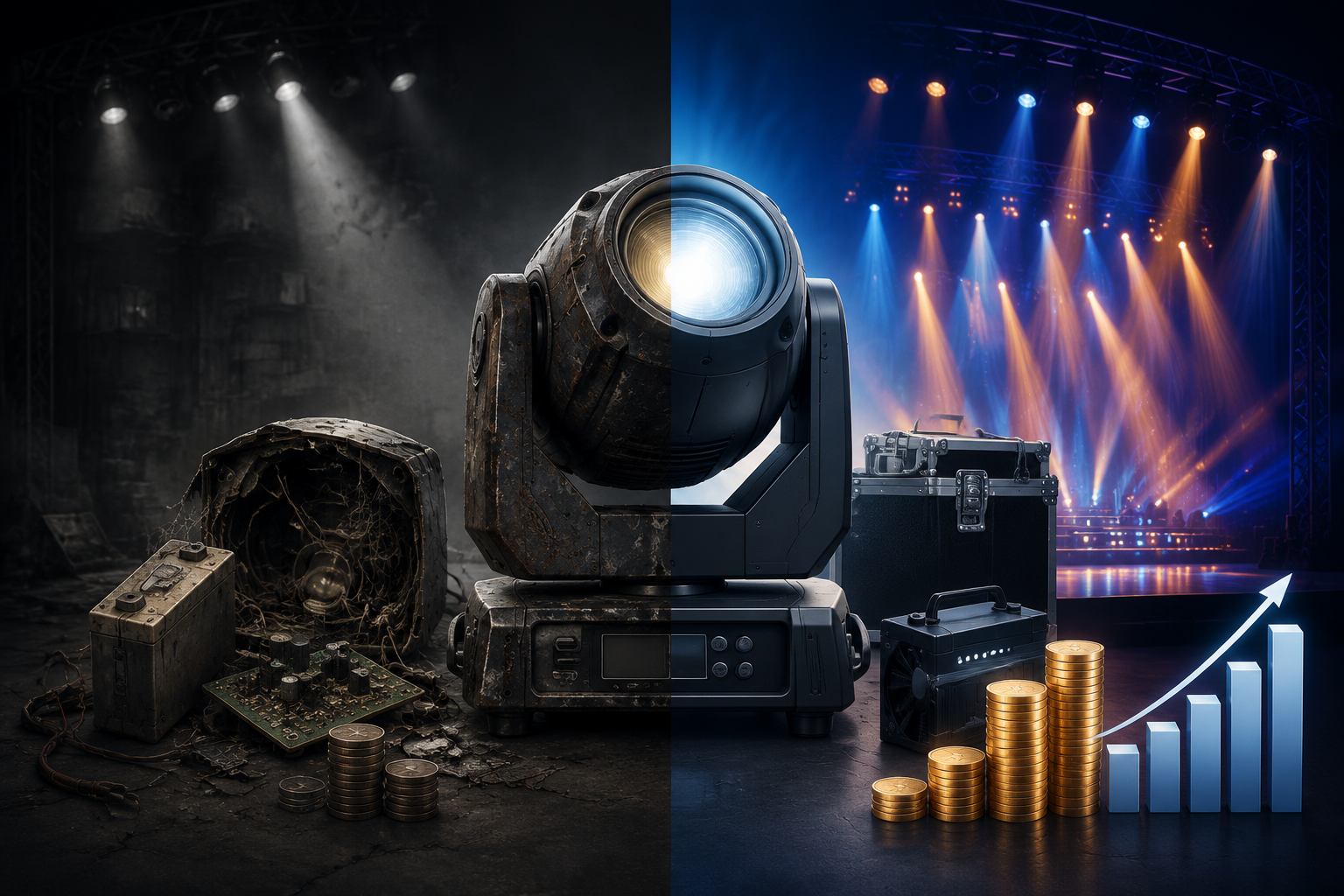
When buyers search for stage lighting price, they often compare only catalog prices from different suppliers. At first glance, one moving head light might cost $200 while another costs $600, and the decision seems simple.
However, in professional entertainment, rental, or installation projects, the real cost of stage lighting equipment is never just the sticker price. The true stage lighting cost includes design quality, materials, energy efficiency, logistics, and maintenance over years of use.
A cheap fixture may look attractive initially, but hidden costs accumulate quickly in real-world usage.
2. Price Composition: What You Are Actually Paying For
Understanding stage lighting equipment prices requires breaking down internal cost structure.
2.1 Light Source (LED / Lamp Engine)
The light source is the core cost driver.
High-quality LED chips (CREE, Osram, Philips)
Higher brightness efficiency
Longer lifespan (20,000–50,000 hours)
Stable color temperature
Higher initial cost
Low-cost LED chips (unbranded or low-bin LEDs)
In many cases, 30–40% of stage lighting price differences come directly from LED engine quality.
2.2 Power System & Battery (for wireless fixtures)
Battery-powered stage lighting is increasingly popular.
Battery quality significantly affects long-term stage lighting cost in rental environments.
2.3 Housing Material & Mechanical Structure
The fixture body determines durability.
High-end materials:
Low-end materials:
Structural weakness often leads to failure in touring and outdoor projects, increasing total ownership cost.
3. Hidden Costs: The Real Budget Killer
Even if stage lighting equipment prices look attractive, hidden costs often exceed expectations.
3.1 Shipping & Logistics
Air freight for urgent projects is expensive
Bulky fixtures increase volumetric shipping cost
Protective packaging adds cost per unit
For international buyers, logistics can add 10–25% to total stage lighting price.
3.2 Import Duties & Taxes
Depending on country:
Import VAT (5%–25%)
Customs tariffs
Clearance agent fees
These costs are often ignored during procurement planning but directly impact final budget.
3.3 Energy Consumption Cost
Professional stage lighting systems run for hours.
Over a 3–5 year project lifecycle, energy savings can exceed initial price differences.
3.4 Maintenance & Repair
Maintenance is one of the largest hidden costs:
Low-cost fixtures may require repairs every 6–12 months, while premium fixtures last years with minimal service.
4. Value Investment: Why Cheap Stage Lighting Becomes Expensive
In B2B projects, the cheapest stage lighting price is often the most expensive long-term decision.
4.1 Downtime Costs
When lighting fails during:
Concerts
Corporate events
Touring shows
The cost is not just repair—it includes reputation damage and event disruption.
4.2 Replacement Cycle Trap
Low-end fixtures often last only 1–2 years, while professional-grade systems last 5–10 years.
This creates a cycle:
Cheap purchase → frequent breakdown → replacement → higher total cost
4.3 Compatibility & Integration Issues
Low-cost fixtures often suffer from:
This increases labor cost for technicians and system tuning.
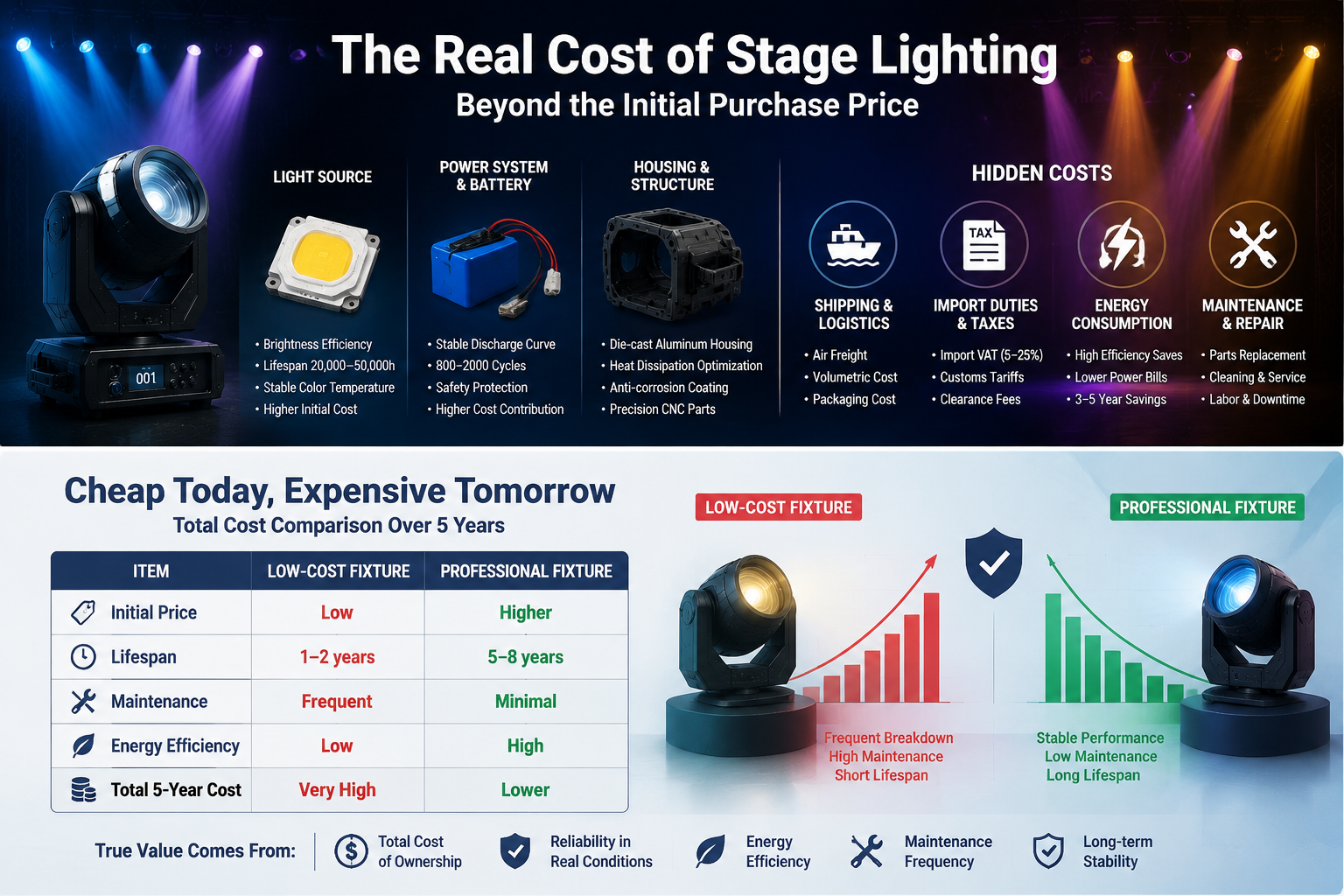
5. Real Example: Total Cost Comparison
| Item | Low-Cost Fixture | Professional Fixture |
|---|
| Initial Price | Low | Higher |
| Lifespan | 1–2 years | 5–8 years |
| Maintenance | Frequent | Minimal |
| Energy Efficiency | Low | High |
| Total 5-Year Cost | Very High | Lower |
This clearly shows that stage lighting cost must be evaluated over lifecycle, not purchase moment.
6. Conclusion: Thinking Beyond Stage Lighting Price
True procurement decisions should focus on:
The real value of professional stage lighting equipment prices lies not in how cheap they are, but in how much cost they save over time.