1. Introduction: Defining Stage Lighting and Its Core Role in the Entertainment Industry
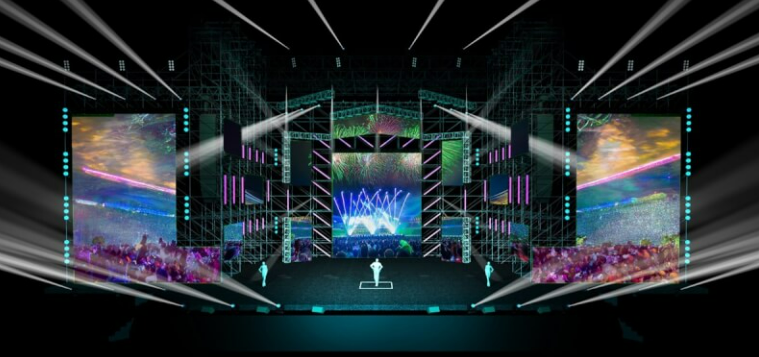
Stage lighting is an essential part of modern entertainment production, combining technology, creativity, and artistic design to create unforgettable visual experiences. The definition of stage lighting goes far beyond simply illuminating performers on a stage. It is a professional system that uses light sources, optical technology, control systems, and installation equipment to shape atmosphere, highlight important moments, and guide audience attention.
From concerts and theatrical performances to corporate events, festivals, clubs, worship spaces, and television productions, professional lighting plays a critical role in storytelling. A carefully designed lighting system can transform an ordinary performance space into an immersive environment filled with emotion, energy, and visual impact.
Understanding stage lighting terminology is essential for lighting designers, technicians, rental companies, and event professionals. Clear communication depends on using accurate industry language. When a designer requests a specific beam angle, Gobo projection, DMX programming setup, or CRI requirement, every member of the production team needs to understand the technical meaning.
As lighting technology continues to develop, modern fixtures such as LED moving heads, waterproof outdoor lights, pixel effects, laser systems, and intelligent control platforms have introduced more advanced concepts into the industry. A professional lighting glossary helps both beginners and experienced users understand these technologies and apply them effectively.
This guide introduces more than 100 important stage lighting terms, focusing on three major categories:
Control and programming terminology
Optical and lighting performance terminology
Installation and equipment terminology
By mastering these concepts, lighting professionals can improve workflow, reduce communication errors, and design more creative stage environments.
2. Core Glossary: Key Stage Lighting Terms Every Professional Should Know
Gobo (Go Between Optics)
One of the most commonly used terms in professional lighting is Gobo.
Many people ask: “What does Gobo stand for?”
Gobo means Go Between Optics. It refers to a metal or glass template placed inside a lighting fixture between the light source and the lens system.
The main purpose of a Gobo is to create projected patterns, shapes, textures, or logos on a stage surface.
Common Gobo designs include:
Stars
Windows
Leaves
Abstract patterns
Company logos
Custom event graphics
Modern moving head profile lights and LED spot fixtures often include rotating Gobo wheels, allowing lighting designers to create dynamic visual effects.
For concerts, weddings, theaters, and corporate events, Gobo projection adds depth and creativity to lighting design.
DMX (Digital Multiplex)
DMX is one of the most important control terms in stage lighting.
DMX stands for Digital Multiplex, a communication protocol used to control professional lighting equipment.
Through DMX signals, lighting consoles can control:
Brightness
Color
Pan and tilt movement
Focus
Zoom
Gobo rotation
Prism effects
Strobe speed
A single DMX universe usually contains 512 channels, with each channel representing a specific control value.
For example:
Channel 1: Dimmer
Channel 2: Red color
Channel 3: Green color
Channel 4: Blue color
Channel 5: Pan movement
Modern lighting systems may also use Art-Net, sACN, and network-based control technologies, but DMX remains the foundation of professional stage lighting.
Lux
Lux is a measurement unit describing illumination intensity.
It measures how much light reaches a specific surface area.
The higher the Lux value, the brighter the illuminated surface appears.
Lighting professionals use Lux measurements to evaluate:
Stage brightness
Projection distance
Fixture performance
Audience visibility
For example, a high-power LED moving head used for outdoor concerts requires higher illumination levels than a small indoor decorative fixture.
Lux testing helps manufacturers and lighting designers select suitable equipment for different applications.
CRI (Color Rendering Index)
CRI means Color Rendering Index.
It measures how accurately a light source reproduces the true colors of objects compared with natural sunlight.
The CRI scale ranges from 0 to 100.
Higher CRI values mean more realistic color reproduction.
Professional applications such as:
Theater productions
Studio lighting
Fashion shows
Museums
Architectural lighting
often require high CRI performance.
A fixture with excellent brightness but poor CRI may make skin tones, products, and scenery appear unnatural.
CCT (Correlated Color Temperature)
CCT describes the color appearance of white light and is measured in Kelvin (K).
Typical values include:
2700K–3200K: Warm white
4000K–4500K: Neutral white
5600K–6500K: Daylight white
Lighting designers select different CCT values depending on the atmosphere they want to create.
Warm white lighting creates comfortable and emotional environments, while cooler white lighting produces a modern and energetic feeling.
3. Technical Classification: Breaking Down Stage Lighting Terms by Control, Optics, and Installation
To better understand professional lighting systems, stage lighting terminology can be divided into three main technical categories: control systems, optical technology, and installation equipment.
Each category represents an important part of a complete lighting solution. Control determines how fixtures operate, optics determine how light is shaped and presented, while installation ensures safety, reliability, and flexibility.
A. Control & Programming Terminology
DMX512
DMX512 is the standard digital communication protocol used in stage lighting control.
It allows lighting consoles, controllers, and software systems to communicate with lighting fixtures.
A DMX system can control hundreds of parameters, including:
Intensity
Color mixing
Movement
Effects
Speed
Special functions
It remains one of the most widely used technologies in theaters, concerts, clubs, and event productions.
Universe
A DMX universe refers to a group of 512 DMX channels.
Large productions often require multiple universes because modern fixtures may use dozens of channels.
For example:
A simple LED PAR light may require 6–12 channels.
A professional moving head may require 30–50 channels.
Multiple universes allow complex lighting systems to operate smoothly.
Channel
A channel represents an individual control parameter within a DMX system.
Examples include:
Dimmer channel
Red color channel
Green color channel
Blue color channel
Pan movement channel
Tilt movement channel
Lighting programmers assign different functions to channels when creating lighting shows.
Lighting Console
A lighting console is the main control device used by lighting operators.
It allows technicians to:
Program scenes
Create effects
Control fixtures
Manage live performances
Professional consoles such as MA Lighting systems, ChamSys, Avolites, and other platforms are widely used worldwide.
Cue
A cue is a programmed lighting scene or moment.
During a performance, lighting operators trigger cues according to the show timeline.
Examples:
Cue 1: Opening stage wash
Cue 2: Performer spotlight
Cue 3: Concert color change
Cue 4: Finale effect
Cues allow complex productions to run accurately.
Preset
A preset is a saved lighting setting that can be reused.
Lighting designers often save presets for:
Colors
Positions
Effects
Fixture configurations
Presets improve programming efficiency and reduce setup time.
Chase
A chase is a sequence of lighting actions played automatically.
Common chase effects include:
Flashing patterns
Moving color sequences
Running lights
Rhythm effects
Chases are frequently used in concerts, DJs, clubs, and entertainment shows.
Fade Time
Fade time controls how quickly one lighting state changes into another.
A slow fade creates a smooth cinematic transition.
A fast fade creates energetic effects suitable for concerts and dance events.
RDM (Remote Device Management)
RDM is an extension of DMX technology.
It allows lighting controllers to communicate back with fixtures.
With RDM, technicians can:
Detect fixtures automatically
Change DMX addresses remotely
Monitor equipment status
This improves efficiency during installation and maintenance.
Art-Net
Art-Net is a network-based lighting control protocol.
It transfers DMX data through Ethernet networks.
Advantages include:
Longer transmission distance
Multiple universes
Integration with computer systems
Large concerts and architectural projects often use Art-Net systems.
B. Optical & Light Performance Terminology
Beam Angle
Beam angle describes the width of light emitted from a fixture.
A narrow beam angle creates concentrated light.
A wide beam angle creates broader illumination.
Examples:
Beam lights: Sharp and narrow beams
Wash lights: Wide coverage
Profile lights: Adjustable projection
Choosing the correct beam angle is important for achieving the desired visual effect.
Beam Light
A beam light produces a powerful narrow beam that can travel long distances.
Typical applications include:
Concert stages
Festivals
Nightclubs
Outdoor events
Modern LED beam moving heads create impressive aerial effects when combined with haze or fog.
Spot Light
A spotlight creates focused illumination on a specific area.
It is commonly used for:
Performers
Objects
Stage areas
Presentations
Spot fixtures usually provide precise control over focus and projection.
Wash Light
A wash light provides broad and even illumination.
It is mainly used for:
Stage backgrounds
Large areas
Architectural surfaces
LED wash lights are popular because they provide excellent color mixing and energy efficiency.
Profile Light
A profile light is designed for precise projection.
It usually includes:
Adjustable focus
Zoom lens
Gobo system
Iris control
Profile fixtures are widely used in theaters and professional events.
Fresnel
A Fresnel light uses a special lens design to create soft-edged illumination.
It is commonly found in:
Theater lighting
Film production
Studio environments
Fresnel fixtures provide smooth coverage and adjustable beam sizes.
Par Light
PAR stands for Parabolic Aluminized Reflector.
PAR lights are simple and powerful fixtures used for general stage illumination.
Modern LED PAR lights provide:
RGB color mixing
Low power consumption
Long lifespan
Lumen
Lumen measures the total amount of visible light produced by a fixture.
Higher lumen output generally means greater brightness.
Manufacturers use lumen ratings to describe LED fixture performance.
Illuminance
Illuminance refers to the amount of light received by a surface.
It is measured in Lux.
It helps designers evaluate whether a lighting system provides enough brightness for a specific application.
Color Wheel
A color wheel is a mechanical or electronic system used to create different colors.
Traditional fixtures use physical color filters.
Modern LED fixtures use RGB, RGBW, RGBA, and RGBAL mixing technology.
CMY Color Mixing
CMY refers to:
Cyan
Magenta
Yellow
Professional moving heads often use CMY systems for smooth color mixing.
Compared with traditional color wheels, CMY provides more continuous color transitions.
CTO (Color Temperature Orange)
CTO is a filter or electronic function used to convert cooler white light into warmer tones.
It is commonly used in:
Moving heads
Profile fixtures
Film lighting
Iris
An iris controls the size of the light beam.
It works similarly to a camera aperture.
Lighting designers use iris adjustment to create:
Narrow beams
Wide projections
Special focus effects
Zoom
Zoom changes the beam angle of a fixture.
A zoomable moving head can switch between:
Wide wash effects
Narrow beam effects
This makes one fixture suitable for multiple applications.
Prism
A prism splits one beam into multiple beams.
Common effects include:
Multi-beam patterns
Rotating visual effects
Increased stage depth
Frost Filter
A frost filter softens the beam edge.
It creates smoother light distribution and reduces harsh shadows.
C. Installation & Hardware Terminology
Truss
A truss is a structural aluminum framework used for supporting lighting equipment.
Applications include:
Concert stages
Exhibition booths
Event structures
Clubs
Professional trusses must meet safety standards for weight capacity.
Clamp
A clamp attaches lighting fixtures to truss systems.
Common types include:
Half coupler
Quick clamp
Omega clamp
Folding clamp
A high-quality clamp ensures fixture stability.
Safety Cable
A safety cable is a secondary safety device attached between the fixture and support structure.
Its purpose is preventing equipment from falling if the main clamp fails.
Safety cables are essential for professional stage installations.
Rigging
Rigging refers to the process of installing and suspending lighting equipment.
Professional rigging requires knowledge of:
Weight limits
Load distribution
Safety regulations
Installation methods
IP Rating
IP rating describes the protection level of lighting equipment against dust and water.
Examples:
IP20: Indoor use
IP65: Dustproof and water-resistant
IP66: Higher outdoor protection
Outdoor stage lighting often requires IP65 or higher protection.
PowerCON
PowerCON is a locking AC power connector system.
It provides:
Secure connection
Reliable power transmission
Professional touring compatibility
Flight Case
A flight case is a protective transport box used for professional equipment.
It protects lighting fixtures during:
Transportation
Touring
Storage
Conclusion
Mastering stage lighting terminology is an important step for anyone working in the entertainment industry.
From understanding what does Gobo stand for to learning DMX control, optical performance, and installation safety, professional vocabulary helps lighting teams communicate more effectively and create better productions.
A complete lighting glossary is not only useful for beginners but also serves as a valuable reference for experienced designers, technicians, rental companies, and event professionals.
As LED technology, intelligent control systems, and outdoor lighting solutions continue to evolve, understanding these terms allows professionals to select the right equipment, optimize performance, and create unforgettable visual experiences.
BLUE SEA LIGHTING continues to provide professional stage lighting solutions, including LED moving heads, waterproof outdoor fixtures, effect lights, and customized lighting systems for global entertainment applications.



Blue Sea Lighting is an enterprise with rich experience in the integration of industry and trade in stage lighting and stage special effects related equipment. Its products include moving head lights, par lights, wall washer lights, logo gobo projector lights, power distributor, stage effects such as electronic fireworks machines, snow machines, smoke bubble machines, and related accessories such as light clamps.
Quick Links
For more questions subscribe to our email