_GWEjzy.jpg)
In professional lighting design, transitions are everything. A perfect fade can stir emotion, guide attention, or create a seamless visual rhythm. But too often, even sophisticated lighting setups suffer from abrupt fades, jarring transitions, or awkward dimming curves that break immersion.
If your current lights fade too fast, too choppy, or too suddenly, this article explores how to solve that—starting with the right fixture choices. We’ll dive into the technology behind smooth dimming, and show how the Big K10 Bee Eye 19x15W LED Moving Head Light and the 7x40W Bee Eye RGBW Zoom LED Moving Head Light can transform your lighting from mechanical to magical.
1. Why Smooth Fading Matters
Lighting is not just about illumination—it’s about emotion and timing. Whether you're lighting a slow ballad, a wedding entrance, or a dramatic pause in a theater scene, the fade curve becomes the heartbeat of the moment.
Problems with abrupt fades:
Distracting intensity drops
Inconsistent timing across fixtures
Harsh color-to-black transitions
Mechanical-looking cue endings
The solution? High-resolution dimming engines, linear or exponential fade curves, and optical diffusion support—all found in the fixtures we’ll explore next.
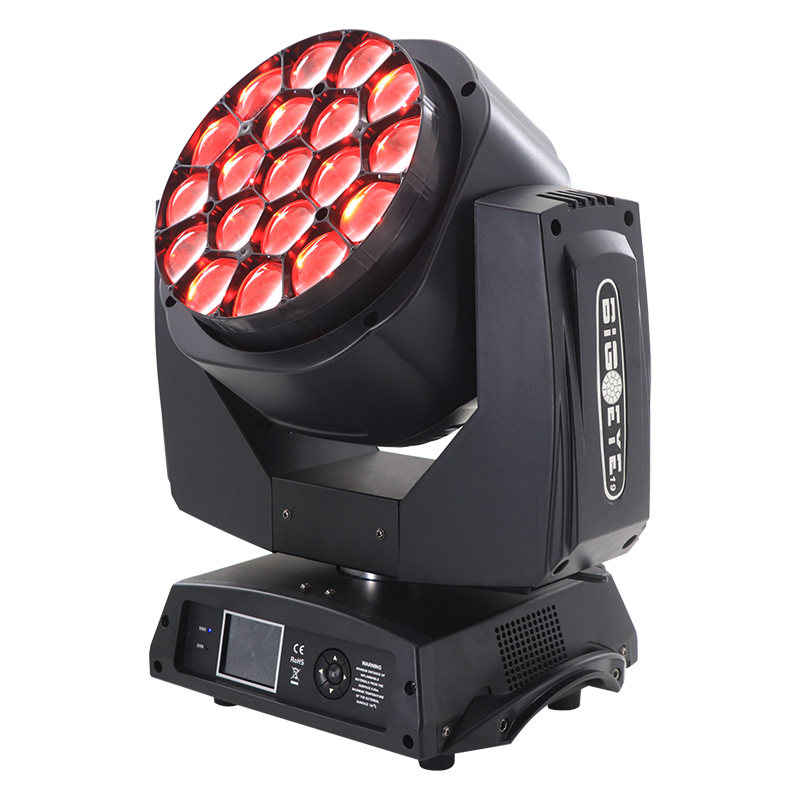
2. Feature Focus: Big K10 Bee Eye 19x15W LED Moving Head Light
The Big K10 Bee Eye 19x15W LED Moving Head Light is built for shows that demand professional-grade transitions, especially in high-profile concerts and broadcasts.
Why it excels at smooth fades:
16-bit dimming system ensures over 65,000 steps of brightness gradation
Independent pixel control enables organic fading across the beam array
Wash + Beam + FX Modes mean you can tailor fades for different effects
RGBW 4-in-1 LEDs allow nuanced color-to-black fades without “color pop” glitches
In a dance production scenario, the Big K10 Bee Eye 19x15W LED Moving Head Light was used to simulate moonlight dimming behind fog—achieving a 5-second fade-out so smooth it felt like breathing. No flicker. No jump. Just perfect disappearance.
With built-in macros and DMX-mapped fade presets, the Big K10 Bee Eye 19x15W LED Moving Head Light simplifies programming smooth transitions for any show.
3. Feature Focus: 7x40W Bee Eye RGBW Zoom LED Moving Head Light
When space is tighter or beams need to be faster yet smoother, the 7x40W Bee Eye RGBW Zoom LED Moving Head Light offers a compact but equally expressive solution.
Smooth transition strengths:
40W high-powered LEDs with soft edges help diffuse fades naturally
Zoom range from 4° to 60° offers fade control from pin-sharp to wide coverage
Individual pixel dimming adds complexity to fade effects
Silent fan system supports use in acoustic-sensitive venues where abrupt cues distract
One lighting designer used the 7x40W Bee Eye RGBW Zoom LED Moving Head Light to simulate candlelight flicker fading to complete darkness over 8 seconds. The results were indistinguishable from real flame dimming.
You can trust the 7x40W Bee Eye RGBW Zoom LED Moving Head Light for scenarios requiring emotional fades—memorials, intimate music performances, immersive installations, or weddings.
4. Dimming Architecture: What Makes a Fixture Fade Well?
A. 16-Bit Resolution Dimming
Both the Big K10 Bee Eye 19x15W LED Moving Head Light and the 7x40W Bee Eye RGBW Zoom LED Moving Head Light support 16-bit dimming—critical for smooth curves. It means:
No visible “steps” in brightness
Better curve shaping (linear, exponential, logarithmic)
Predictable cue programming
B. LED Color Mixing and Fade Sync
RGB-based lights often produce an undesirable pop during fade-outs if color intensity drops unevenly. These two fixtures manage synchronized color intensity reduction, ensuring a single smooth fade instead of RGB mismatches.
C. Pixel-Level Control
Fading not only across the whole fixture, but also within the pixel grid, lets you simulate:
Fireflies fading in sequence
Stars blinking off in waves
Emotional crescendo lighting effects
5. Creative Applications of Smooth Fading
| Scenario | Fade Use |
|---|---|
| Theater scene change | 6-second fade to black |
| Wedding first dance | 8-second warm fade-in with zoom softening |
| Ambient lounge | Auto cycling pastel fades every 3s |
| Memorial tribute | 15-second single beam dimming into haze |
| Ballet | Pixel chase with subtle left-to-right fading movement |
Both the Big K10 Bee Eye 19x15W LED Moving Head Light and the 7x40W Bee Eye RGBW Zoom LED Moving Head Light are flexible enough to adapt to these uses with preprogrammed cues or DMX live control.
6. How to Program a Better Fade
Use these techniques:
Set fade time in seconds, not frames—minimum 3s for visible effect
Choose exponential fade curves for more emotional roll-off
Test in a haze-rich environment to assess beam shape while fading
Avoid crossfading hard colors unless using soft macros
Both the Big K10 Bee Eye 19x15W LED Moving Head Light and the 7x40W Bee Eye RGBW Zoom LED Moving Head Light support curve selection directly via DMX channel assignment.
7. Summary: Choose the Right Tool for the Right Fade
If your lights fade too abruptly, chances are you’re using fixtures without professional dimming systems.
The Big K10 Bee Eye 19x15W LED Moving Head Light is a perfect solution for large stages needing deep fades and rich dynamics. The 7x40W Bee Eye RGBW Zoom LED Moving Head Light, on the other hand, is ideal for smaller environments or detailed transitions that require finesse.
Use them separately, or combine them to achieve fade layers from background wash to foreground effects—all while keeping transitions buttery smooth.
READ MORE:



Blue Sea Lighting is an enterprise with rich experience in the integration of industry and trade in stage lighting and stage special effects related equipment. Its products include moving head lights, par lights, wall washer lights, logo gobo projector lights, power distributor, stage effects such as electronic fireworks machines, snow machines, smoke bubble machines, and related accessories such as light clamps.
Quick Links
For more questions subscribe to our email