In professional lighting—whether for stage, film, architecture, or retail—color consistency is critical. A vibrant wash of red should look equally vibrant across the entire rig; skin tones should render naturally; brand colors should appear as intended. And yet, lighting designers and technicians often face frustrating inconsistencies: one fixture emits a slightly cooler white than the others, or a cluster of LEDs produce visibly uneven tones. The culprit? Often, it comes down to LED chip binning.
This article demystifies LED binning, explains its impact on real-world lighting performance, and offers strategies for ensuring uniformity across your fixture inventory.
What Is LED Chip Binning?
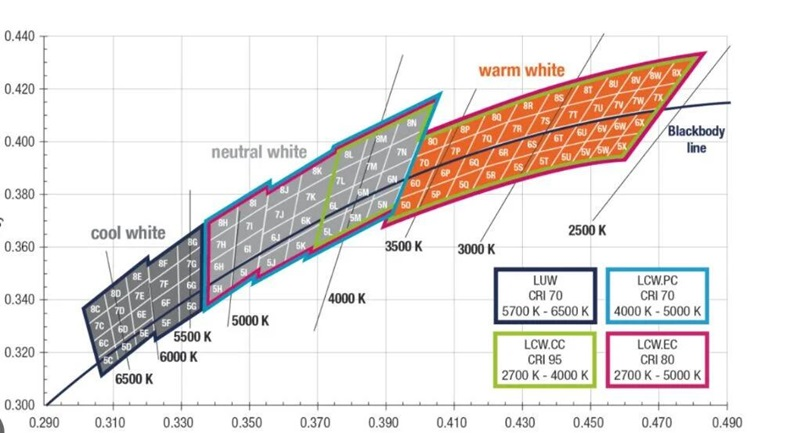
LED chip binning is a sorting process used during LED manufacturing. LEDs—like all semiconductor products—are subject to slight variations during production. After fabrication, manufacturers test and categorize the chips based on key performance attributes:
Color temperature (CCT)
Luminous flux (brightness)
Forward voltage
Chromaticity coordinates (xy location on the color space)
Each range within these categories is called a “bin.” For instance, a batch of 3000K warm white LEDs may contain chips that slightly deviate: 2970K, 3020K, 3080K, etc. To minimize perceptual differences in final products, manufacturers bin chips with similar properties together and sell or deploy them accordingly.
Why Binning Matters in Stage & Architectural Lighting
For residential or industrial lighting, small deviations in color are often imperceptible. But in stage, studio, museum, and architectural lighting, the human eye and camera sensors are far more sensitive to:
White balance shifts across multiple fixtures
Uneven wall washes in RGB/A/UV mixing
Color fringing during projection or gobos
Inconsistent color fades in live programming
Using fixtures with unmatched LED bins can result in:
“Patchy” washes
“Warm-to-cool” transitions across trusses
Skin tones that look flat or greenish on camera
Thus, binning consistency becomes a core concern for lighting designers and buyers.
Binning Tolerances and Standards
The most common metric for color variation is Standard Deviation of Color Matching (SDCM), also known as MacAdam ellipses. Here's what those levels mean in practice:
| SDCM Level | Color Consistency Interpretation |
|---|---|
| 1–2 | Nearly indistinguishable to human eye |
| 3–4 | Minor variation, acceptable for commercial use |
| 5–6 | Noticeable shifts, problematic for high-end lighting |
| 7+ | Poor consistency, avoided in quality control |
High-end fixture manufacturers often use ≤3 SDCM bins for white LED chips to ensure tight tolerance, especially in fixed installations.
RGB vs White LED Binning
In white LEDs, binning mostly affects CCT and brightness. But in RGB or RGBW systems, binning has a multi-dimensional impact:
Red LEDs may vary in wavelength (e.g., 615nm vs 630nm)
Green may shift from bluish to yellowish hues
Blue impacts overall saturation and white balance when mixed
In LED stage lighting, even small differences in the red bin can result in a noticeable hue shift when trying to produce pinks, lavenders, or skin tones.
To complicate things further, mixing different color LEDs (as in RGBWA+UV chips) introduces combinatorial variance, requiring ultra-precise binning across multiple wavelengths.
How Binning Affects Fixture Manufacturing
Fixture makers source LEDs in large quantities. However, to maintain production cost efficiency, they may:
Mix bins within a tolerance level
Accept broader ranges for budget products
Match bins per production batch, but not across batches
This means that two fixtures from the same model line, but manufactured six months apart, might emit slightly different tones. The more budget-friendly the product line, the more likely this is to happen.
Premium brands often:
Pre-select narrow bins
Lock bin specifications per model
Use mixing algorithms or color calibration at factory level
Strategies for Ensuring Color Consistency
Lighting designers, rental companies, and venue managers can mitigate binning inconsistencies with these practices:
1. Purchase Fixtures in Batches
Order all units for a venue or tour from the same production batch. Request bin codes if the manufacturer allows it.
2. Ask for Bin Control Policy
Reputable manufacturers will disclose their binning strategy, including:
CCT tolerance (e.g., ±50K)
SDCM levels
Whether bins are mixed in a single fixture or kept uniform
3. Use Calibration Tools
Software like fixture auto-calibration, pixel mapping correction, or DMX white balance control can help standardize colors across a mixed rig.
4. Specify Binning Standards in Procurement
In tenders or venue upgrade specs, include requirements like:
“All white LEDs ≤ 3 SDCM”
“All RGB LEDs matched by dominant wavelength”
“Factory bin report provided with shipment”
5. Test Before Installation
Use a calibrated spectrometer to compare outputs from sample units before committing to full deployment—especially when ordering from multiple suppliers.
The Future of Binning: Smart Compensation
As demands for uniformity rise, some manufacturers are embedding firmware-level color compensation based on bin data. This allows:
Fixture-to-fixture tuning via controller presets
Self-adjusting output to match a master fixture
Batch-aware pixel mapping in touring setups
While this is still an emerging field, it's likely that future lighting control systems will integrate bin-aware profiles, allowing designers to eliminate bin-based shifts entirely.
Final Thoughts
LED chip binning may seem like a behind-the-scenes detail, but its impact on stage and architectural lighting is front and center. From washed-out wall washes to uneven fades and color mismatches on camera, inconsistent binning is one of the most common—yet underrecognized—sources of lighting frustration.
By understanding the principles of binning, asking the right questions, and sourcing carefully, professionals can ensure that every beam of light carries not just intensity—but intention.
READ MORE:



Blue Sea Lighting is an enterprise with rich experience in the integration of industry and trade in stage lighting and stage special effects related equipment. Its products include moving head lights, par lights, wall washer lights, logo gobo projector lights, power distributor, stage effects such as electronic fireworks machines, snow machines, smoke bubble machines, and related accessories such as light clamps.
Quick Links
For more questions subscribe to our email